Chasing the Stripes: Top Tiger Shark Dives
If you are an ocean enthusiast with a penchant for adrenaline, chances are you have a bucket list. And if you are a scuba diver, it is highly likely that somewhere near the very top of that list is an encounter with one of the ocean’s most magnificent and misunderstood apex predators: the tiger shark.
For decades, popular culture has painted these creatures with a broad, terrifying brush. But talk to anyone who has actually shared the water with a tiger shark, and they will paint a very different picture. They will describe an animal of profound grace, intense curiosity, and undeniable majesty. Diving with tiger sharks is not about conquering a monster; it is about stepping into a wild, untamed world and being granted a fleeting audience with its undisputed royalty.
If you have ever dreamed of leaving the cage behind and coming face-to-face with these striped giants, you are in the right place. What makes tiger sharks so fascinating? What are the very real risks and immense thrills of encountering them, and what are some top destinations around the globe where you can safely join them in the blue.
Getting to Know the “Dustbin of the Sea”
To truly appreciate the experience of diving with tiger sharks, you must first understand the animal itself. The tiger shark (Galeocerdo cuvier) is an incredibly formidable creature, recognized as one of the largest predatory sharks in the world. Females are typically larger than males and can easily grow between 10 to 14 feet in length, with some massive individuals reaching up to 18 feet and weighing in at over 2,000 pounds. They are instantly recognizable by their broad, blunt snouts and the dark, vertical stripes that run along their flanks—the characteristic that gives them their feline namesake. Interestingly, these stripes are highly prominent in juveniles to help camouflage them in the dappled light of the shallows, but as the sharks mature and grow older, the bold patterns slowly fade, sometimes becoming almost invisible in fully grown adults.
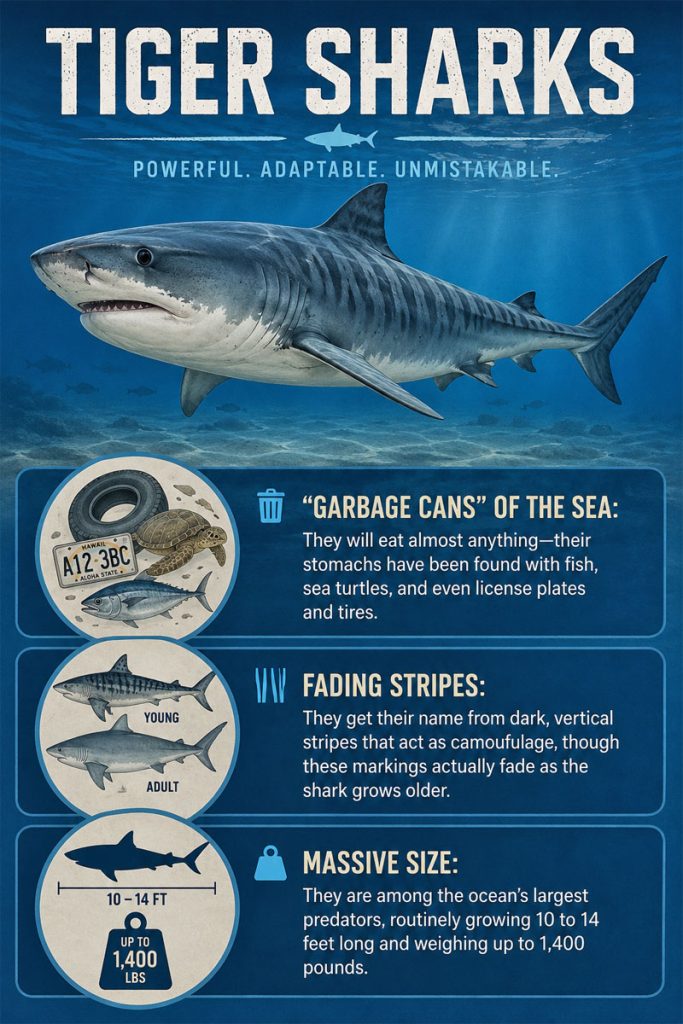
Perhaps the most famous – and somewhat comical – reputation the tiger shark holds is its nickname: the “dustbin of the sea”. These sharks are famously non-fussy eaters with a remarkably diverse palate. While their natural diet consists of fish, crustaceans, dolphins, and sea turtles (whose hard shells are no match for the shark’s powerful jaws and heavy, serrated teeth), they are highly opportunistic. Tiger sharks will scavenge on dead whales and have even been known to consume man-made garbage, with everything from license plates to old tires being found in their stomachs. Despite being capable of this indiscriminate consumption, they are actually highly effective ambush predators. They are generally slow-moving, preferring to cruise lazily through the water to conserve energy, but they can unleash explosive bursts of speed when a genuine hunting opportunity arises.
Beyond their size and diet, tiger sharks are highly evolved, nomadic travelers. They undertake massive oceanic migrations, moving seamlessly between warm tropical environments and temperate waters depending on the season and food availability. They are also predominantly nocturnal hunters. To aid them in the dark, they possess a specialized layer of reflective tissue behind their retinas called the tapetum lucidum. This is the exact same biological feature that causes a cat’s eyes to glow in the dark, granting the tiger shark exceptional night vision to patrol the reefs when the sun goes down.
The Primal Thrill and the Inherent Risks
Let’s address the elephant—or rather, the massive shark—in the room. Diving with an apex predator of this size is not a theme park ride. It is a genuine wildlife encounter with an animal that is fully capable of lethal force. Statistically speaking, the tiger shark is second only to the great white shark in recorded fatal attacks on humans. Because of their immense power, any bite, even an exploratory one, can be devastating. Most incidents involving humans are cases of mistaken identity, often occurring in murky coastal waters or at the surface where surfers and swimmers mimic the silhouette of a struggling turtle or seal.
However, in a controlled scuba diving environment, the dynamic shifts entirely. When you are submerged in clear water with excellent visibility, the sharks know exactly what you are. You are not on their menu. Diving with tiger sharks requires strict adherence to safety protocols. Divers are taught to maintain eye contact—tiger sharks are ambush predators, and letting them know they are seen changes their approach—keep their heart rates down, hold their position, and keep their arms close to their bodies. By minimizing sudden movements and respecting their personal space, humans can safely observe them in their element.
The reward for following these rules is a thrill that is practically indescribable. It is a potent cocktail of primal vulnerability and overwhelming awe. When a 14-foot tiger shark emerges from the edge of your visibility and slowly glides toward you, time seems to stop. They are deeply intelligent, curious animals, and they will often make calm, deliberate eye contact with divers. Being accepted into the domain of such a powerful creature, watching its muscles ripple beneath its battle-scarred skin, completely rewires your brain. It transforms the “man-eater” myth into a deep, abiding respect for one of nature’s most perfectly engineered survivors.
Tiger Beach, Grand Bahama (The Bahamas)
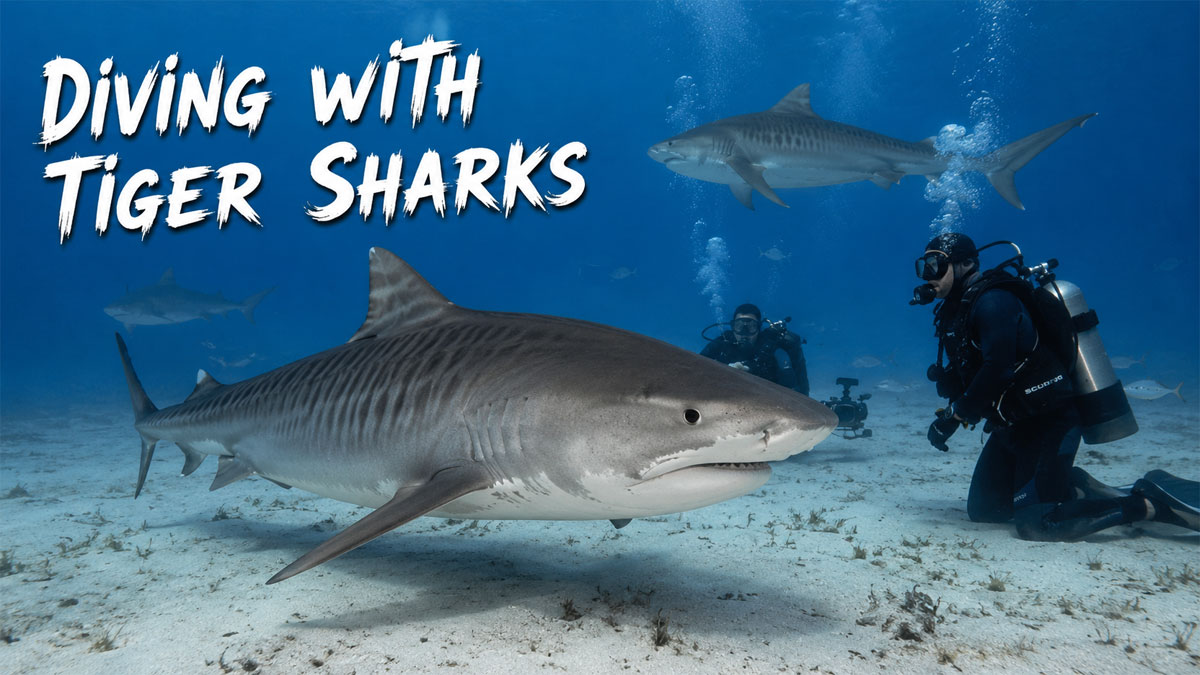
If you have ever seen a high-definition photograph of a massive tiger shark cruising over a pristine, rippled white sandbar in shallow, crystal-clear water, you were likely looking at Tiger Beach. Located about 20 miles off the West End of Grand Bahama, Tiger Beach isn’t an actual beach at all. It is a shallow, submerged sandbank that sits at a comfortable depth of just 8 to 10 meters (about 25 to 35 feet).
This site is widely considered the global mecca for tiger shark photography and cage-free encounters. The setup is relatively straightforward: divers descend to the sandy bottom and comfortably kneel in a line while the dive guides safely manage the interaction. Because the water is incredibly clear—often boasting 100 feet of visibility—and the depth is so shallow, you can enjoy long bottom times bathed in natural sunlight. The resident female tiger sharks here are accustomed to divers and are known to glide majestically right over the heads of the group. Adding to the magic, the waters are absolutely teeming with other species; it is common to share your dive with dozens of lemon sharks, Caribbean reef sharks, and huge, docile nurse sharks.
Fuvahmulah, Maldives
For divers looking for a completely different backdrop, the island of Fuvahmulah in the Maldives is rapidly becoming one of the most exciting shark diving destinations on the planet. Unlike the shallow sandy banks of the Bahamas, Fuvahmulah offers dramatic blue-water diving. It is a single-island atoll located deep in the southern Maldives, very close to the equator. Because the island’s drop-off connects directly to the deep, open ocean, it acts as a magnet for massive pelagic life.
Diving here is an immersion into the deep blue. Local dive operators have established a highly controlled, conservation-minded approach to these encounters, prioritizing education and deep-water safety. While tiger sharks are guaranteed year-round and are the undisputed stars of the show, the unique underwater topography means you never quite know what else will swim out of the gloom. Divers at Fuvahmulah frequently encounter elegant thresher sharks utilizing shallow cleaning stations, alongside oceanic manta rays, whale sharks, and even schools of hammerheads. It is a rugged, dynamic environment that showcases the tiger shark in a truly wild, oceanic context.
Protea Banks, South Africa
If Tiger Beach is the gentle, sunlit studio and Fuvahmulah is the deep oceanic theater, Protea Banks is the untamed frontier. Located about 7.5 kilometers off the coast of Shelly Beach in KwaZulu-Natal, South Africa, this destination is strictly for advanced and experienced divers. Protea Banks is a massive, fossilized sandstone reef system sitting at a depth of between 27 and 40 meters (90 to 130 feet).
The diving here is defined by high energy and powerful elements. Warm waters from the Agulhas Current sweep across the deep reef, bringing a nutrient-rich soup that attracts an astonishing concentration of big predators. Protea Banks is believed to be a breeding and birthing ground for tiger sharks, and the best time to see these massive specimens is from late February through early June. Encounters here are exhilarating drift dives in strong currents. You aren’t just looking for tiger sharks; you are diving in a thriving, predatory ecosystem. On any given dive, you might share the water with notorious Zambezi (bull) sharks, ragged-tooth sharks, blacktips, and migrating schools of scalloped hammerheads. It is big-animal diving at its most pure and adrenaline-fueled.
Earning Your Stripes
Choosing to dive with tiger sharks is not a decision to be taken lightly. It requires a solid foundation of diving skills, emotional control, and an immense amount of respect for the ocean’s boundaries. But for those willing to take the plunge, the experience is nothing short of life-altering.
Leaving the water after a successful tiger shark encounter leaves you with a profound sense of privilege. You quickly realize that these animals are not the mindless eating machines portrayed on television. They are calculated, majestic, and vital to the health of our oceans. Whether you are kneeling in the sun-kissed sands of the Bahamas, floating in the equatorial blue of the Maldives, or drifting along the rugged coasts of South Africa, sharing the ocean with a tiger shark is an adventure that will stay etched in your memory long after your gear has dried.