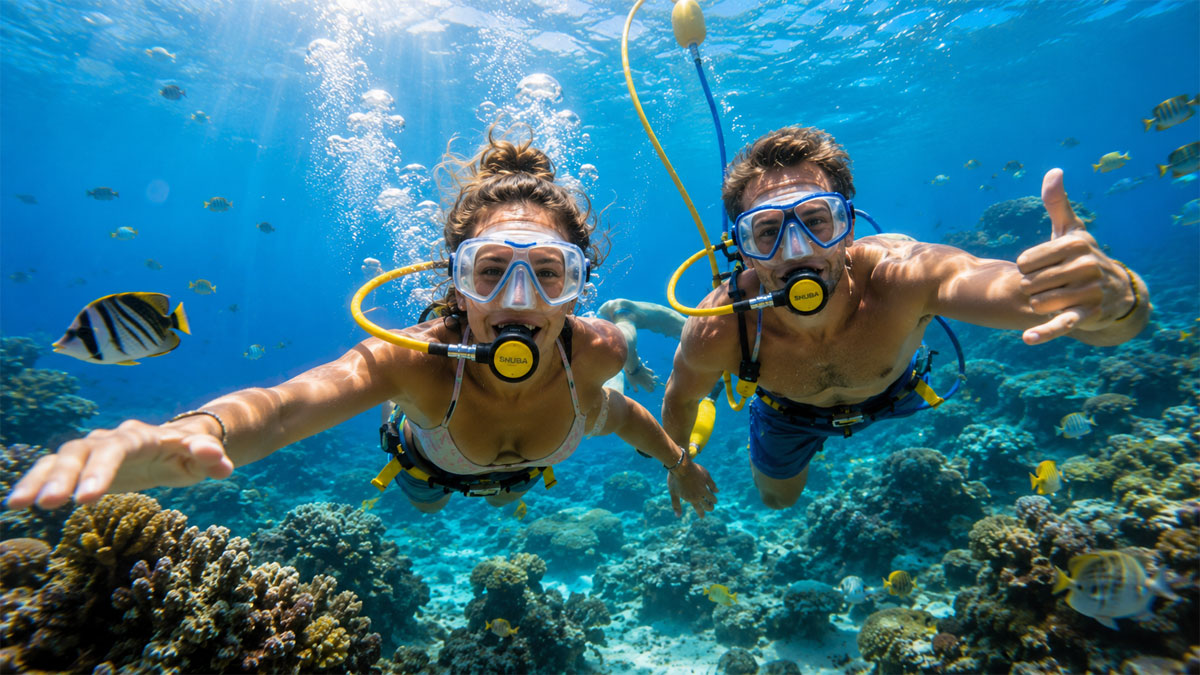
SNUBA Diving Explained: Locations, Safety, and FAQs
Have you ever looked out at the ocean and wished you could explore the underwater world, but felt held back by the hassle of heavy scuba gear or the limits of snorkeling? If so, SNUBA diving might be exactly what you are looking for. As marine tourism continues to evolve into 2026, this genius hybrid of snorkeling and scuba diving is becoming one of the most sought-after vacation activities.
Here is an extensive guide to what SNUBA diving is, its advantages, where you can try it, and how to stay safe while doing it.
What is SNUBA Diving?
SNUBA (a clever combination of the words “snorkel” and “scuba”) is a shallow-water diving system that allows you to breathe underwater without wearing heavy, restrictive scuba cylinders on your back. Instead of carrying your air supply, your oxygen tank safely floats on a specially designed raft at the surface of the water.
You breathe through a standard scuba regulator connected to an air line (a long hose) attached to the surface raft. The floating raft follows your movements from above, allowing you to easily descend and explore the ocean up to a maximum depth of 20 feet (about 6 meters). Because you are constantly connected to your air supply on the surface, you cannot get lost, and you always have an easy, tethered route back up.
The Advantages of SNUBA Diving
SNUBA diving bridges the gap between shallow snorkeling and full-on scuba diving. Here are some of the biggest advantages:
- No Certification Required: Unlike traditional scuba diving, which requires days of classroom theory and pool practice, SNUBA requires no formal certification. A brief 15 to 30-minute safety and skills orientation is all it takes before you hit the water.
- No Heavy Equipment: A standard scuba tank and buoyancy device can weigh well over 40 pounds. With SNUBA, you only wear a swimsuit, a lightweight harness, a mask, fins, and a weight belt. This makes it incredibly freeing and accessible.
- Dive Deeper than Snorkeling: Snorkelers are mostly confined to the surface and must hold their breath to dive down. SNUBA allows you to stay submerged for 30 to 45 minutes, fully immersing yourself in the marine environment.
- Choose Your Own Depth: You are not forced to dive to the maximum 20-foot limit. If you feel comfortable staying at 5 or 10 feet below the surface, you can do so while your dive buddy swims deeper.
Who is SNUBA Diving For?
SNUBA is an incredibly inclusive activity designed for almost anyone who wants to explore the sea. It is highly recommended for:
- Families: SNUBA is a fantastic multi-generational activity. Kids aged 8 and up can participate in standard SNUBA dives, while children aged 6 and 7 can participate in “SNUBA Doo,” a surface-based program where they wear a life vest and breathe from a regulator without descending.
- Non-Certified Divers: If you want to experience the thrill of breathing underwater but don’t have the time or budget to get a scuba certification during your holiday, SNUBA is the ultimate shortcut.
- People with Physical Limitations: Because it removes the heavy lifting of traditional scuba tanks, SNUBA is much friendlier for individuals who might have weak knees, a bad back, or generally struggle with heavy gear on a moving boat.
(Note: While you do not need to be an Olympic athlete, a basic level of physical fitness and general comfort in the water are required.)
3 Amazing SNUBA Diving Locations
Thanks to its growing popularity, you can experience SNUBA in tropical and coastal destinations around the world.
United States: Maui, Hawaii
Hawaii is famous for its vibrant marine life, and Maui is one of the premier locations for SNUBA in the US. Many operators offer boat trips to Molokini Crater, a partially submerged volcanic crater boasting visibility that often exceeds 100 feet. Swimming among Hawaiian green sea turtles and colorful reef fish with an air hose keeping you safely tethered is a bucket-list experience.
Europe: Tenerife, Canary Islands (Spain)
If you are vacationing in Europe, the Spanish Canary Islands are an excellent place for underwater adventures. Tenerife offers SNUBA diving tours in the clear, subtropical waters of the Atlantic Ocean. The island’s underwater volcanic landscapes, curious rays, and schools of native fish create a breathtaking backdrop for those trying out the sport without heavy scuba tanks.
Punta Cana, Dominican Republic
The Caribbean Sea is arguably the SNUBA capital of the world. In Punta Cana, you can combine SNUBA diving with snorkeling and boat tours. The warm, turquoise waters and bustling coral reefs of the Dominican Republic provide an unforgettable environment to breathe underwater and marvel at the tropical marine life.
Essential Safety Tips for SNUBA Diving
While SNUBA is highly supervised and exceptionally safe, it is still a form of diving. Keep these crucial safety tips in mind:
- Never Hold Your Breath: Just like in scuba diving, the golden rule of SNUBA is to breathe continuously. Holding your breath while ascending can cause serious lung expansion injuries due to changes in water pressure.
- Equalize Early and Often: As you descend, the water pressure increases, which can cause discomfort in your ears. Pinch your nose and blow gently to “pop” or equalize your ears. Do this frequently as you pull yourself down the air line.
- Use the Line to Control Your Ascent: Your air hose acts as your personal descent and ascent line. Always use a hand-over-hand motion to slowly climb the line back to the surface raft, ensuring you don’t ascend too quickly.
- Look, Don’t Touch: Practice good marine stewardship. Do not touch coral reefs, chase sea turtles, or disturb the natural habitat.
7 Frequently Asked Questions (FAQs) About SNUBA
1. How deep can you go with SNUBA?
The maximum depth allowed is 20 feet (about 6 meters). However, you can stay at any depth above that where you feel most comfortable.
2. Do I need to be a strong swimmer?
No. You do not need to be a strong swimmer because you are attached to a highly buoyant surface raft. As long as you are comfortable in the water, can breathe through a mouthpiece, and can kick your fins, you will be fine.
3. How old do you have to be to SNUBA dive?
To participate in standard SNUBA, you must be at least 8 years old. Children who are 6 or 7 years old can join the fun through the “SNUBA Doo” program, where they stay buoyant on the surface wearing a life vest while breathing through the regulator.
4. Is SNUBA diving safe?
Yes. SNUBA is highly controlled. The raft is highly visible to boat traffic to keep you safe from above. Plus, you are limited to a shallow depth, meaning you cannot get lost, and you are constantly guided by a trained professional.
5. How long does a SNUBA dive last?
On average, a dive lasts between 30 and 40 minutes underwater. The exact duration depends on how heavily you breathe; a calmer breathing rate means your air supply lasts longer.
6. Can I fly immediately after SNUBA diving?
Because the maximum depth is only 20 feet, the risk of decompression sickness is very minimal. However, the general safety recommendation is to wait at least 4 hours after a SNUBA dive before flying or going to high-altitude areas like a mountain.
7. What equipment do I need to wear?
You simply wear your normal swimsuit. The tour operator will provide the rest: a diving mask, swim fins, a lightweight harness, and an optional weight belt to help you descend easily. In colder waters, they may also provide a wetsuit.