The North Atlantic “Cold Blob”: New Study Links Ocean Cooling to a Weakening Current System
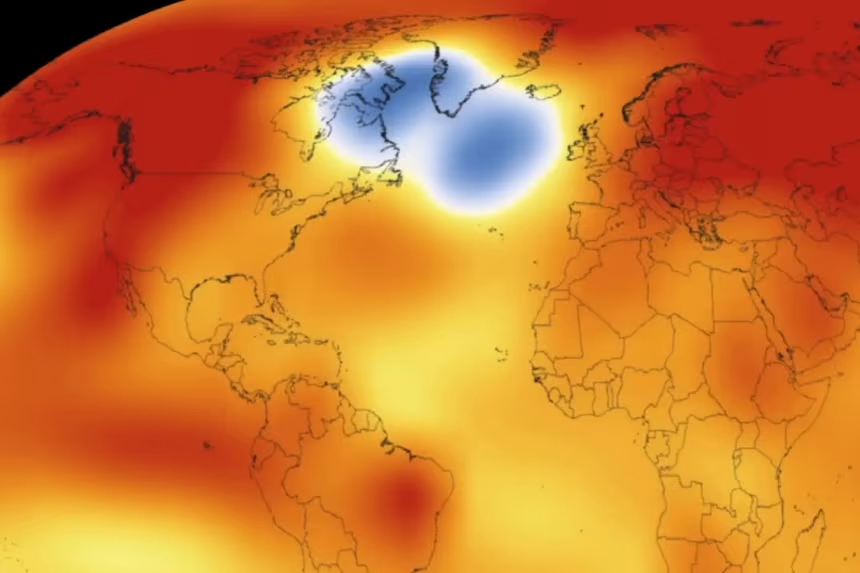
While global ocean temperatures continue to rise, a specific region in the North Atlantic—located south of Greenland and Iceland—is doing the opposite. Known to scientists as the “cold blob” or “warming hole,” this patch of water has cooled by nearly 1 degree Celsius (1.8 degrees Fahrenheit) since 1900.
For years, researchers have debated the primary driver behind this cooling anomaly. Some attributed it to atmospheric changes, such as shifts in winds and cloud cover that cause heat loss at the ocean surface. Others argued it is a physical indicator of a weakening Atlantic Meridional Overturning Circulation (AMOC)—the critical system of ocean currents that transports heat northward.
A new study suggests the latter explanation is the primary driver, offering fresh insight into a system that plays a fundamental role in regulating the global climate.
Deep-Ocean Cooling and the AMOC
To better understand the mechanisms at play, the authors of the study combined real-world ocean temperature data from instruments and satellites with advanced climate models.
They discovered that the cooling in this region is not merely a surface-level phenomenon driven by atmospheric conditions. Instead, the cooling extends deep into the ocean, where winds and clouds have a much weaker influence. According to the researchers, this deep-water cooling points directly to changes in ocean heat transport.
The AMOC functions much like a vast conveyor belt. It pulls warm, salty water from the tropics to the Northern Hemisphere. As this water reaches northern latitudes, it cools, increases in density, sinks, and flows back south along the ocean floor. However, rising global temperatures and melting ice sheets are introducing large volumes of freshwater into the North Atlantic. This influx dilutes the salinity of the water, making it lighter and less prone to sinking, which gradually slows the entire circulation process.
A significant disruption or collapse of the AMOC would have far-reaching global consequences. Potential impacts include accelerated sea-level rise along the eastern coast of North America, significantly colder winters across Europe, and shifts in monsoon patterns that could trigger prolonged droughts in parts of Africa.
Weighing the Evidence
According to Stefan Rahmstorf, a study co-author and professor of physics and oceans at Potsdam University in Germany, the study indicates that changes in ocean heat transport are actively driving the cold blob’s development. Rahmstorf noted that this finding aligns with other independent research suggesting the AMOC is currently at its weakest state in approximately 1,000 years.
Outside experts have welcomed the findings but urge a balanced interpretation. René van Westen, a marine and atmospheric researcher at Utrecht University who was not involved in the study, noted that while prior research showed atmospheric conditions alone could generate a cold blob, the consistent results across different datasets in this new study strengthen the argument for an ocean-driven cause.
However, other scientists caution that the debate is not entirely resolved. David Thornally, a professor of ocean and climate science at University College London, agreed that the study bolsters the link between the cold blob and a weakening AMOC. Nonetheless, he pointed out that real-world ocean data remains relatively sparse, meaning existing datasets are best viewed as approximations rather than perfect representations.
Jonathan Baker, a senior climate scientist at the UK Met Office, shared a similar perspective, suggesting that while the study adds valuable weight to the hypothesis of an AMOC contribution, it represents a continuation of the scientific dialogue rather than a final, definitive conclusion.