Scuba Certification Compared: PADI, SSI, NAUI & CMAS
Welcome to the incredible world of scuba diving! If you are reading this, you have likely decided to take the plunge, leave gravity behind, and learn how to breathe underwater. You are about to unlock access to 71% of the planet that most people will only ever see on television.
But before you can start swimming alongside sea turtles, exploring sunken shipwrecks, or marveling at vibrant coral reefs, you have to get certified. And as soon as you start looking into scuba diving courses, you will inevitably hit a wall of confusing acronyms: PADI, SSI, NAUI, CMAS, and more.
If you are a beginner wondering, “Which scuba diving agency is the best?” or “Will my certificate be recognized if I travel?” you are not alone. This is the single most common question asked by new divers all over the world.
In this guide, we are going to demystify the “alphabet soup” of scuba diving. We will compare the world’s four major recreational diving agencies – PADI, SSI, NAUI, and CMAS – to help you decide which path is right for you.
Understanding Scuba Diving Agencies: What Do They Actually Do?
Before we pit these agencies against each other, it is crucial to understand what a scuba diving agency actually is – and what it isn’t.
A scuba diving agency is an organization that develops the educational curriculum, sets the safety standards, and issues the certification cards (often called “C-cards”) that prove you are a trained diver. Think of them like educational boards or “universities”. They write the textbooks, create the online learning platforms, and train the instructors.
However, the agencies themselves do not usually own the dive shops. When you walk into a dive center in Thailand, Mexico, Egypt, or your local city, you are walking into an independent business that has chosen to affiliate with one (or more) of these agencies.
It’s no Secret: They All Teach You to Dive Safely
Here is the most important secret in the scuba diving industry: All major agencies teach the same fundamental physics, physiology, and safety skills.
Why? Because the major agencies adhere to global safety standards set by the World Recreational Scuba Training Council (WRSTC) and the International Organization for Standardization (ISO). Whether you train with PADI, SSI, NAUI, or CMAS, you will learn how to clear water from your mask, how to recover a lost regulator, how to control your buoyancy, and what to do in an emergency.
Because they all meet these global ISO standards, their certifications are recognized worldwide. If you get certified with an agency in Australia, you can seamlessly rent tanks or join a dive boat in the Caribbean or the Mediterranean.
How the Beginner Scuba Course Works
Regardless of which agency you choose, the beginner entry-level course is universally divided into three main components:
- Knowledge Development (Theory): This is where you learn the physics of diving, how pressure affects your body, how to use dive tables or dive computers, and the rules of the underwater world. Today, almost all agencies offer this via e-learning on your smartphone or laptop.
- Confined Water Dives (Pool Training): Before you go into the ocean, you will practice in a swimming pool or a calm, shallow body of water. Here, you will take your first underwater breaths and practice essential survival and comfort skills in a totally safe environment.
- Open Water Dives: The grand finale! You will complete a series of open water dives (usually four or five) in the ocean, a lake, or a quarry. You will demonstrate the skills you learned in the pool to your instructor, all while enjoying the local marine life.
Once you complete these three steps, you earn your entry-level certification, which allows you to dive autonomously with a buddy (without an instructor holding your hand) anywhere in the world.
Now, let’s dive into the specifics of the top four global agencies to see how their approaches differ.
PADI (Professional Association of Diving Instructors)
Website: https://www.padi.com
If you have heard of only one scuba diving agency, it is almost certainly PADI. Founded in 1966 in the United States, PADI is the undeniable giant of the scuba industry. They issue more scuba certifications globally than all the other agencies combined. PADI is to scuba diving what Kleenex is to tissues—the brand name is often used interchangeably with the activity itself.
Core Philosophy
PADI’s philosophy is built on standardized, accessible, and commercial education. Their motto is “The Way the World Learns to Dive.” They realized early on that to make diving popular, it needed to be broken down into easily digestible, progressive steps. PADI courses are highly structured. An instructor must teach skills in a very specific, rigid sequence. This ensures that a student learning in a murky lake in the UK receives the exact same educational foundation as a student learning in the crystal-clear waters of the Maldives.
The Beginner Course: PADI Open Water Diver
- Max Depth: 18 meters / 60 feet.
- Duration: Typically 3 to 4 days.
- Note on Naming: Be careful not to confuse this with the “PADI Scuba Diver” course, which is a shorter, restricted subset of the Open Water course that only allows you to dive to 12 meters under the direct supervision of a professional. You want the Open Water Diver certification.
Pros of Choosing PADI
- Unmatched Global Reach: You will find PADI dive centers in practically every corner of the globe. If you are a traveler, PADI is the ultimate passport.
- Exceptional Materials: PADI’s e-learning and physical manuals are highly polished, user-friendly, and available in dozens of languages.
- Consistency: Because of their strict adherence to a specific teaching sequence, you know exactly what you are getting.
Cons of Choosing PADI
- Rigid Structure: The strict teaching order can be a drawback for some. If you are struggling with a specific skill (like taking your mask off underwater), the instructor cannot simply skip it, teach you three other things to build your confidence, and come back to it later. You must complete the sequence.
- Cost: PADI is often the most expensive option. Students are required to purchase their own learning materials directly from PADI, and the certification fees tend to be higher.
Who is PADI Best For?
PADI is absolutely perfect for travelers, backpackers, and holidaymakers who want a globally recognized certification quickly and efficiently. If you want the comfort of knowing that your certification will be instantly recognized by any dive shop on Earth, PADI is a fantastic choice.
SSI (Scuba Schools International)
Website: https://www.divessi.com
Founded in 1970 and currently owned by the sporting goods giant HEAD/Mares, SSI is the second-largest scuba agency in the world and PADI’s biggest direct competitor. In recent years, SSI has seen massive growth, particularly in popular tourist destinations like Southeast Asia, Central America, and Europe.
Core Philosophy
SSI’s philosophy centers around the concept of the “Dive Professional and Dive Center.” Unlike PADI instructors who can operate independently, SSI instructors must be affiliated with a physical SSI dive center. This ensures a high level of quality control and local mentorship. Furthermore, SSI places a heavy emphasis on repetition and “comfort through repetition.” They give their instructors more flexibility to adapt to the student’s needs.
The Beginner Course: SSI Open Water Diver
- Max Depth: 18 meters / 60 feet.
- Duration: Typically 3 to 4 days.
- Digital First: SSI was the pioneer in shifting the diving industry toward digital learning.
Pros of Choosing SSI
- Flexibility in Teaching: This is SSI’s biggest advantage. If you are having a hard time mastering a specific skill in the pool, an SSI instructor is allowed to pause, move on to other skills to help you build confidence, and return to the problematic skill later. This personalized approach often results in less stress for nervous beginners.
- Cost-Effective and Free App: The SSI app (MySSI) is incredible. Often, when you sign up with an SSI dive shop, your digital learning materials are included for free or at a significantly lower cost compared to PADI.
- Strong Community: Because instructors are tied to specific shops, SSI fosters a strong sense of local community, loyalty, and mentorship.
Cons of Choosing SSI
- Slightly Smaller Network: While SSI is massive and universally recognized, there are still a few remote islands or specific locales where PADI holds a monopoly. However, any reputable shop will accept an SSI card.
- Tied to a Shop: If you start your e-learning with an SSI shop but decide to move to another country to finish your physical dives (a “referral”), it can sometimes be slightly more administratively complex than PADI’s open system.
Who is SSI Best For?
SSI is ideal for budget-conscious travelers, digital natives who love learning via apps, and individuals who might be a bit nervous about the water and would benefit from a flexible, personalized teaching approach.
NAUI (National Association of Underwater Instructors)
Website: https://www.naui.org
Founded in 1959, NAUI is the oldest recreational scuba certifying agency in the United States. Unlike PADI and SSI, which are commercial, for-profit businesses, NAUI is a 501(c)(3) non-profit educational association. NAUI has a prestigious reputation; it is the agency of choice for NASA’s Neutral Buoyancy Laboratory, the US Navy SEALs, and many university diving programs across the United States.
Core Philosophy
NAUI operates on the philosophy of “Dive Safety Through Education.” Their most distinguishing feature is Academic Freedom. NAUI believes that the instructor is the ultimate authority, not the agency rulebook. Therefore, NAUI instructors are allowed—and actively encouraged—to exceed the minimum standards if they feel the local environment requires it. A famous NAUI motto given to instructors is: “Would I allow this person to dive with my loved ones?” If the answer is no, the student does not pass, regardless of whether they technically ticked all the boxes.
The Beginner Course: NAUI Scuba Diver
- Max Depth: 18 meters / 60 feet.
- Note on Naming: Notice that NAUI calls their entry-level course “Scuba Diver”, whereas PADI and SSI call it “Open Water Diver”. (Remember, PADI’s “Scuba Diver” is only a half-certification, but NAUI’s “Scuba Diver” is the full, autonomous 18m certification).
Pros of Choosing NAUI
- Academic Rigor: NAUI courses are famous for being thorough. You will likely learn more about the heavy science, physics, and physiology of diving than you would in a fast-paced commercial course.
- Highly Skilled Instructors: Because NAUI allows instructors to add skills to the curriculum, you are often trained to handle environments specific to your area (e.g., cold water, heavy currents, or low visibility).
- Non-Profit Ethos: Your money goes toward an educational association rather than corporate shareholders.
Cons of Choosing NAUI
- Limited Global Availability: Outside of the United States, South America, and parts of Asia, NAUI dive centers can be hard to find. You won’t easily stumble across a NAUI shop on a random beach in Thailand or the Red Sea compared to PADI or SSI.
- Longer Courses: Because of the academic rigor, a NAUI course might take longer than a standard 3-day resort course.
Who is NAUI Best For?
NAUI is perfect for people who live in the US and are learning to dive at home, university students, military personnel, and academic-minded individuals who don’t just want to know how to dive, but want to deeply understand the why behind every rule.
CMAS (Confédération Mondiale des Activités Subaquatiques)
Website: https://www.cmas.org
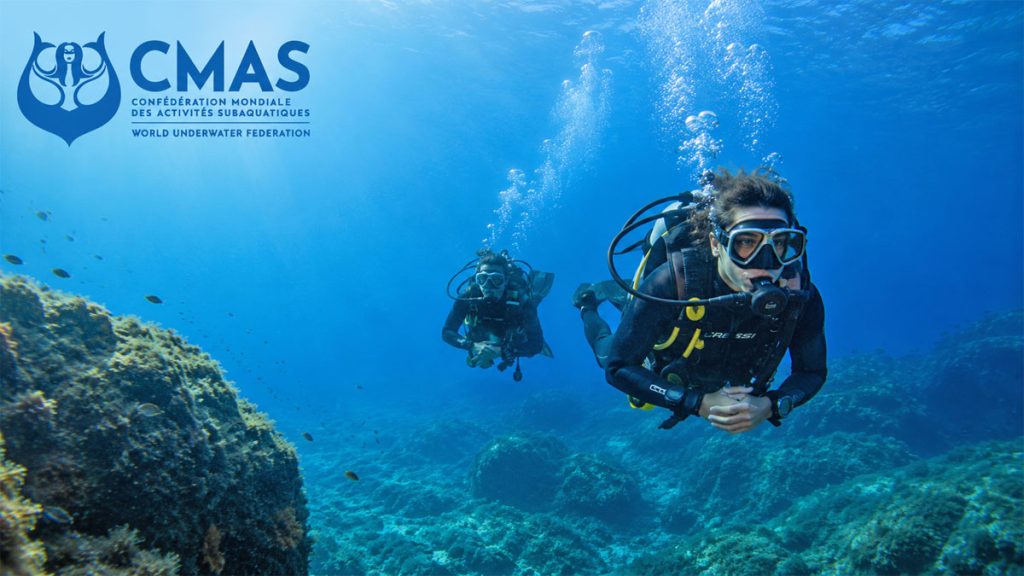
If PADI is the commercial king of the USA, CMAS is the historic grandfather of Europe and the rest of the world. Founded in 1959 by none other than Jacques-Yves Cousteau, CMAS translates to the “World Underwater Federation”.
Core Philosophy
CMAS operates completely differently from PADI, SSI, or NAUI. It is not a single corporation, but rather an international umbrella organization that oversees national diving federations. For example, if you learn to dive in France, you will likely learn with the FFESSM. In the UK, you might learn with BSAC. In Israel, it’s the Israeli Diving Federation. These national bodies are all part of the CMAS family.
CMAS diving is heavily rooted in a club-based culture. You don’t usually go to a commercial shop for three days; instead, you join a local dive club, train in a pool every Tuesday night over several months, and eventually go to the ocean with your club members.
The Beginner Course: CMAS 1-Star Diver
- Max Depth: 20 meters / 65 feet. (Note: This is slightly deeper than the 18m limit of the commercial agencies, reflecting CMAS’s rigorous training standards).
- Duration: Can range from an intensive week to several months of weekly club meetings.
Pros of Choosing CMAS
- Exceptional Skill Level: CMAS training is widely considered to be among the most athletic, demanding, and thorough in the world. CMAS divers are often praised for their incredible competence in the water.
- Community and Mentorship: Because it is club-based, you aren’t just a paying customer; you are a club member. You will build long-term relationships with mentors and dive buddies.
- Low Long-Term Cost: Dive clubs are usually non-profit. Instructors are often volunteers teaching for the love of the sport. While you pay a yearly club membership, the actual training and gear rental can be astonishingly cheap over time.
Cons of Choosing CMAS
- Time Consuming: If you are going on a tropical vacation next week, CMAS is not for you. The training takes time.
- Language and Localization: Because CMAS is run by national federations, finding English materials or courses can sometimes be tricky if you are living in a non-English speaking country.
- Less Commercial Convenience: You won’t find the glossy, gamified e-learning apps that SSI and PADI offer. It is a more old-school, traditional approach.
Who is CMAS Best For?
CMAS is the ultimate choice for people who want to learn to dive locally in Europe or areas where CMAS dominates. It is perfect for those who want diving to become a lifelong hobby anchored by a local community, rather than just an activity they do once a year on vacation.
The Ultimate Agency Comparison Table
To help you summarize all this information, here is a quick, easy-to-read comparison of the four major agencies:
| Feature | PADI | SSI | NAUI | CMAS |
|---|---|---|---|---|
| Organization Type | For-Profit / Commercial | For-Profit / Commercial | Non-Profit Educational | Non-Profit / Federation |
| Beginner Course Name | Open Water Diver | Open Water Diver | Scuba Diver | 1-Star Diver |
| Max Depth (Beginner) | 18m / 60ft | 18m / 60ft | 18m / 60ft | 20m / 65ft |
| Learning Structure | Highly structured, rigid order | Flexible, adaptable order | Academic freedom, thorough | Club-based, highly rigorous |
| Digital Platforms | Excellent, but often an extra cost | Industry-leading, often free with shop | Good, solid academics | Basic, varies by national federation |
| Global Reach | Massive, omnipresent | Huge, rapidly growing everywhere | Strong in US/Americas/Universities | Dominant in Europe & Club systems |
| Best For… | The international traveler | The budget-conscious digital learner | The academic / safety-focused diver | The community-seeking local diver |
Crucial Factors to Consider When Choosing Your First Certificate
Now that you know the players, how do you actually make your choice? Here is some practical advice for the real world.
1. The “Golden Rule” of Scuba: Choose the Instructor, Not the Agency
If you only take one piece of advice from this entire article, let it be this: The quality of your instructor matters 100x more than the logo on your certification card.
A passionate, patient, and experienced PADI instructor will make you a far better diver than a burnt-out, rushed NAUI instructor—and vice versa. When you visit a dive shop, don’t just ask about the price. Ask to meet the instructor who will be teaching you.
- Do they seem friendly and patient?
- Do they answer your questions clearly?
- What is the maximum student-to-instructor ratio? (Ideally, look for classes with no more than 4 to 6 students per instructor).
2. E-Learning vs. Classroom
Think about how you like to learn. If you want to do all your studying on your iPad while flying to your holiday destination, SSI and PADI are going to be your best friends. Their e-learning platforms are slick, feature high-quality videos, and are highly interactive. If you prefer sitting in a classroom, asking complex physics questions, and engaging in deep discussions, look for a local NAUI center or a CMAS dive club.
3. Consider Your Travel Plans
If you are planning to travel the world and dive in remote locations—like small islands in the Philippines, liveaboard boats in the Red Sea, or backpacker hubs in Central America—the commercial giants (PADI and SSI) will make your life slightly easier. While all agencies recognize each other, PADI and SSI digital databases allow dive shops to instantly look up your certification online if you ever lose your physical card. This is a lifesaver when traveling.
4. Local vs. Resort Learning
- Resort Course: Doing your course on vacation in warm, clear tropical water is beautiful and easy, but it takes 3-4 days out of your holiday. PADI and SSI excel here.
- Local Course: Doing your course at home (in a local quarry, lake, or cold ocean) is harder, but it makes you a much tougher diver. You can complete the pool/theory work over the weekends before your trip. CMAS and NAUI thrive in local environments, though PADI and SSI have massive local presences as well.
The “Crossover” Myth: Can I Mix and Match Agencies?
Many beginners stress over choosing an agency because they think it’s a lifetime contract. It is not.
Because of the global ISO standards we mentioned earlier, you can freely jump between agencies as you continue your scuba education.
For example, you can perfectly execute the following path:
- Complete your beginner PADI Open Water Diver course while on vacation in Mexico.
- Return home and do your SSI Advanced Adventurer course with a local dive shop to learn deep diving and navigation.
- A year later, take a NAUI Rescue Diver course because you found an instructor with an amazing reputation for safety training.
The scuba community is highly interconnected. Do not feel locked into one agency. You can—and arguably should—experience different teaching philosophies as you progress in the sport.
Continuing Education: What Comes After the Beginner Course?
Once you have your entry-level certification, the ocean is literally your oyster. But 18 meters (or 20 meters for CMAS) is just the beginning. All agencies offer a ladder of “Continuing Education” courses to help you dive deeper, stay underwater longer, and handle emergencies.
While the names vary slightly, the path usually looks like this:
- Advanced Diving: (PADI Advanced Open Water, SSI Advanced Adventurer, CMAS 2-Star). This course allows you to dive down to 30 meters (100 feet), teaches you underwater navigation with a compass, and lets you sample specialties like night diving or wreck diving.
- Rescue Diver: (PADI Rescue Diver, NAUI Rescue Scuba Diver). Widely considered the most challenging but rewarding recreational course. You learn how to save panicked divers, manage emergencies, and perform underwater search patterns.
- Divemaster / CMAS 3-Star: This is the first step into the professional realm. As a Divemaster, you can work anywhere in the world, guiding certified divers on underwater tours and assisting instructors with classes.
Taking the Plunge
Choosing your first scuba diving agency is an exciting milestone, but it shouldn’t be a source of stress.
If you want the biggest global network and don’t mind paying a premium for consistency, go with PADI. If you want modern, flexible, digital-first learning tied to a strong local dive shop, SSI is an incredible choice. If you are an academic thinker who values profound safety education over commercial speed, look for NAUI. And if you want to join a tight-knit local community and undergo rigorous, traditional training over time, join a CMAS club.
Ultimately, the ocean does not care which logo is printed on your plastic certification card. The fish won’t ask if you are a PADI diver or a CMAS diver. What matters is that you listen to your instructor, master your buoyancy, respect the marine environment, and never hold your breath.
Find an instructor you connect with, pick the training format that suits your lifestyle, and get ready for the adventure of a lifetime. Welcome to the underwater world – we can’t wait to see you down there!