
Diving Capo D’Acqua: Italy’s Sunken Ghost Town
When people think of scuba diving, their minds immediately drift to tropical oceans, colorful coral reefs, and white sandy beaches. But some of the most extraordinary underwater experiences on earth are hidden far away from the sea. Deep in the heart of Italy, surrounded by the towering peaks of the Apennine Mountains, lies a freshwater dive site that feels like stepping through a time machine.
Welcome to Lago di Capodacqua, also known as Capo D’Acqua Lake. Located in the beautiful, rugged Abruzzo region, about a two-hour drive east of Rome, this small mountain reservoir is practically invisible to the average international tourist. However, for those willing to strap on a scuba tank and brave the chilly mountain waters, it offers a magical journey into a submerged medieval ghost town. Here, you do not just look at history from behind a museum glass; you literally swim through its forgotten doorways.
The History of the Flooded Valley
To understand why there is a medieval settlement sitting at the bottom of a lake, we have to look back to the year 1965. The area is located within the Gran Sasso and Monti della Laga National Park, a lush, mountainous region famous for its pristine natural springs. These local mountain springs naturally feed the Tirino River, which is widely considered to be one of the cleanest and clearest rivers in all of Italy.
In the mid-twentieth century, the local agricultural industry needed a reliable water supply to irrigate the surrounding wheat fields, as well as a way to generate modern hydroelectric power. To solve this problem, a dam was constructed to hold back the upper course of the river. As the dam was completed, the water levels slowly began to rise, swallowing the small green valley piece by piece.
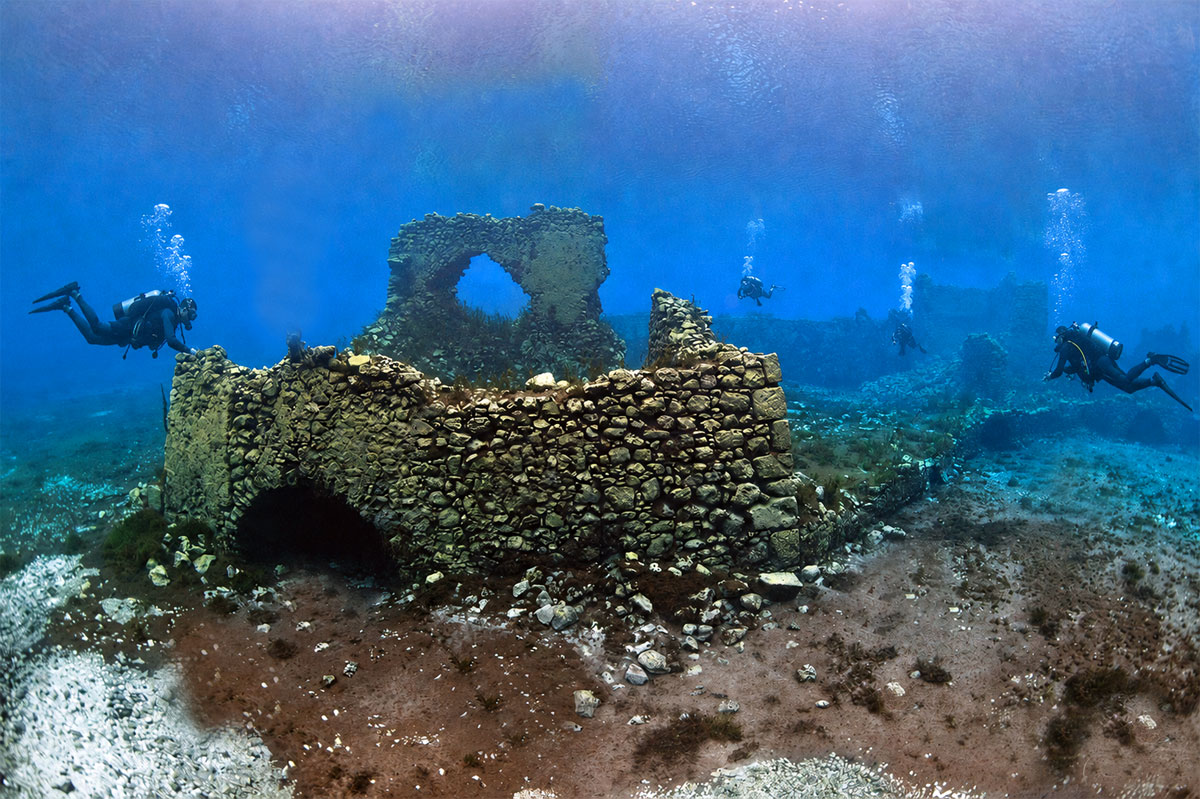
Before the flood, this valley was home to a tiny but bustling agricultural site. For centuries, local farmers had brought their grain to two water-powered stone mills that had been built in the Middle Ages. Alongside the old mills stood a more modern paint factory. When the valley was finally flooded, the paint factory was left partially above the water, but the two medieval mills were entirely swallowed by the rising tide. Today, they remain frozen in time beneath the surface, waiting for divers to explore their quiet, watery halls.
Exploring the Submerged Medieval Mills
Diving in Lago di Capodacqua is a surreal, almost haunting experience. Because the maximum depth of the lake is only about eight to nine meters (roughly 25 to 30 feet), you will not be plunging into a dark, scary abyss. Instead, you slowly descend into a brightly lit, shallow dreamscape.
As you glide away from the entry point, the first things you notice are the ancient stone walls appearing out of the vivid blue. You are actually following the exact same paths that medieval farmers once walked. The original cobblestone roads are still perfectly intact, lined with the eerie, preserved stumps of drowned trees.
Soon, the first of the two mills comes into view. Though hundreds of years old and completely submerged, the structure is remarkably well-preserved. You can peer through the old stone window frames and ruined doorways. If you look closely, you can even see the original wooden blades and wheels that once turned the heavy grinding stones to make flour for the local villages.
Swimming a little further, you will find the second, larger mill. Here, you can float over the old drainage channels and admire the stone pillars that once supported great architectural arches. Sadly, the Abruzzo region was hit by a severe earthquake in 2009, which collapsed the last standing archway of this mill. Yet, even in their ruined state, the buildings possess a quiet, mysterious beauty. Because you are completely weightless in the water, you are able to fly over the rooftops and inspect the ancient masonry from angles that the original builders could never have imagined.
Crystal Clear Spring Water and Unique Wildlife
What truly elevates Lago di Capodacqua to a world-class dive site is the water itself. Because the lake is constantly fed by the natural, underground springs of the Gran Sasso mountains, the water is incredibly pure. During the peak season, the underwater visibility can reach a staggering 70 to 80 meters (230 to 260 feet). You can literally see from one side of the lake to the other. It feels less like swimming in water and more like floating in thin air.
While you will not find the colorful fish of the tropics, the lake has its own fascinating, cold-water ecosystem. The fresh water is home to shy brown trout (often called Fario trout) and small river crayfish that hide among the ancient stones.
If you dive on a bright, sunny day, you will also witness a beautiful natural biological phenomenon. The lake is filled with specific types of underwater plants and tall reeds. Thanks to the intense sunlight piercing the clear, shallow water, the plants go into rapid photosynthesis. As you swim by, you can watch thousands of tiny, sparkling oxygen bubbles rising constantly from the bright green leaves to the surface, creating a magical, bubbling underwater forest.
Practical Information for Divers
While Lago di Capodacqua is accessible to most divers, there are a few very important rules and practicalities you need to know before you pack your dive bags and head to Italy.
First, you cannot simply arrive at the lake, put on your scuba gear, and jump into the water. The reservoir is situated on private property and is heavily protected to preserve both the fragile medieval ruins and the delicate natural ecosystem. Diving is authorized exclusively through one local organization: the Atlantide Scuola Sommozzatori (Atlantide Scuba Diving School), founded by Dante Cetrioli. You must contact them in advance to book a guided dive. Their experienced instructors know the ruins intimately and will ensure you do not accidentally damage the historical structures with your fins.
Second, you need to be prepared for the cold. The mountain spring water sits at a constant 10 degrees Celsius (50 degrees Fahrenheit) all year round. While some brave divers manage the dive in a very thick semi-dry wetsuit with a hood and gloves, a drysuit is highly recommended so you can comfortably enjoy the dive without shivering.
Third, because the lake is situated at an altitude of approximately 330 meters (about 1,080 feet) above sea level, this is officially considered an altitude dive. Because the atmospheric pressure is lower at this height than it is at sea level, you will need to adjust your dive computer settings for altitude diving to accurately track your nitrogen exposure.
Finally, you only need a basic Open Water Diver certification to enjoy this site. The shallow depths and complete lack of water currents make it a very relaxing and safe environment for beginners, provided they are comfortable with the cold temperature and have excellent buoyancy control to avoid kicking up silt from the lake floor.
When to Visit and Final Thoughts
If you want the absolute best conditions, timing your trip is essential. While the diving school operates year-round, the absolute best visibility is usually found during the colder winter months, from November to February. During the height of the summer, the warmer sunlight can cause natural algae blooms in the lake, which may temporarily reduce the visibility to about 15 meters (50 feet). Even with reduced visibility, the dive remains spectacular, but the winter months offer that mind-blowing, crystal-clear experience.
Lago di Capodacqua proves that you do not need an ocean to have an unforgettable dive. The combination of untouched mountain nature, absolute underwater tranquility, and the rare chance to physically swim through a piece of Italian medieval history makes this secret lake a must-do for any adventurous scuba diver. It is a true sunken treasure, hiding in plain sight.