Master Your Hover: How to Perfect SCUBA Buoyancy Control
Welcome, fellow bubble-blowers! Do you remember your first few open water dives? If you spent half the dive inflating and deflating your BCD just to avoid crashing into the reef or popping up to the surface like a cork, you are absolutely not alone. The “yo-yo” dive is a rite of passage for almost every beginner.
Achieving that feeling of weightlessness—perfect neutral buoyancy—is the holy grail of SCUBA diving. It transforms you from a struggling underwater pedestrian into a graceful, gliding aquatic explorer. But don’t worry, neutral buoyancy is not some mystical superpower granted only to divemasters; it is a learned skill that comes down to technique, physics, and practice.
Why Perfecting Your Buoyancy is So Important
Before we talk about how to improve, we need to understand why buoyancy control is widely considered the most important skill in SCUBA diving.
1. Protecting Fragile Marine Ecosystems
Coral reefs are incredibly delicate. Corals are living animals that grow only a few millimeters a year. One stray fin kick or a heavy knee dropped onto a reef by a diver struggling with their buoyancy can destroy decades of growth in an instant. Mastering your hover makes you a responsible, eco-friendly diver.
2. Drastically Improving Air Consumption
Have you ever wondered why your dive guide comes up with half a tank of air while you are already hitting your reserve? Good buoyancy control means you are no longer fighting the water. When you aren’t struggling to stay down or constantly kicking to stay up, you exert far less energy. Less energy exerted means a lower heart rate, which translates to breathing significantly less air.
3. Enhancing Your Safety
Uncontrolled ascents are one of the biggest risks in diving, potentially leading to lung over-expansion injuries or decompression sickness (DCS). Conversely, uncontrolled descents can lead to ear barotrauma or hitting a hazardous bottom. Good buoyancy control ensures your ascents and descents are slow, controlled, and perfectly safe.
4. Making Diving Effortless and Fun
You simply cannot take a crisp, focused macro photograph of a nudibranch if you are bouncing up and down in the water column! When you are neutrally buoyant, you can hover effortlessly, observe marine life peacefully, and truly enjoy the zen-like tranquility of the underwater world.
Practical Tips to Master Your SCUBA Buoyancy
Ready to dial in your dive skills? Here is the most practical advice for locking in that perfect neutral buoyancy.
Nail Your Weighting
The most common mistake new divers make is wearing too much lead. Being overweighted forces you to compensate by pumping large amounts of air into your Buoyancy Control Device (BCD). Because air compresses at depth and expands as you ascend, a large bubble of air in your BCD will expand and contract wildly with even minor depth changes, making it nearly impossible to stay stable.
Actionable Tip: Perform a proper surface weight check. At the surface, with all your gear on and a nearly empty tank (around 50 bar / 500 psi), deflate your BCD completely and hold a normal breath. You should float exactly at eye level. When you exhale, you should slowly begin to sink. If you sink while holding your breath, drop a pound or two!
Master Your Breath Control
Many divers forget that they are swimming around with two natural buoyancy compensators right inside their chests: their lungs! Once you achieve neutral buoyancy with your BCD, you shouldn’t need to touch your inflator hose for minor depth changes.
Actionable Tip: Breathe like a yogi. Slow, deep, and continuous breaths are key. If you are approaching a small coral head and need to rise a foot or two, simply take a slightly deeper, longer inhale. Your lungs will expand, and you will gently lift over the obstacle. To go back down on the other side, exhale deeply and empty your lungs. Anticipate the delay; it usually takes a couple of seconds for your body to react to your breath.
Adjust Your Trim
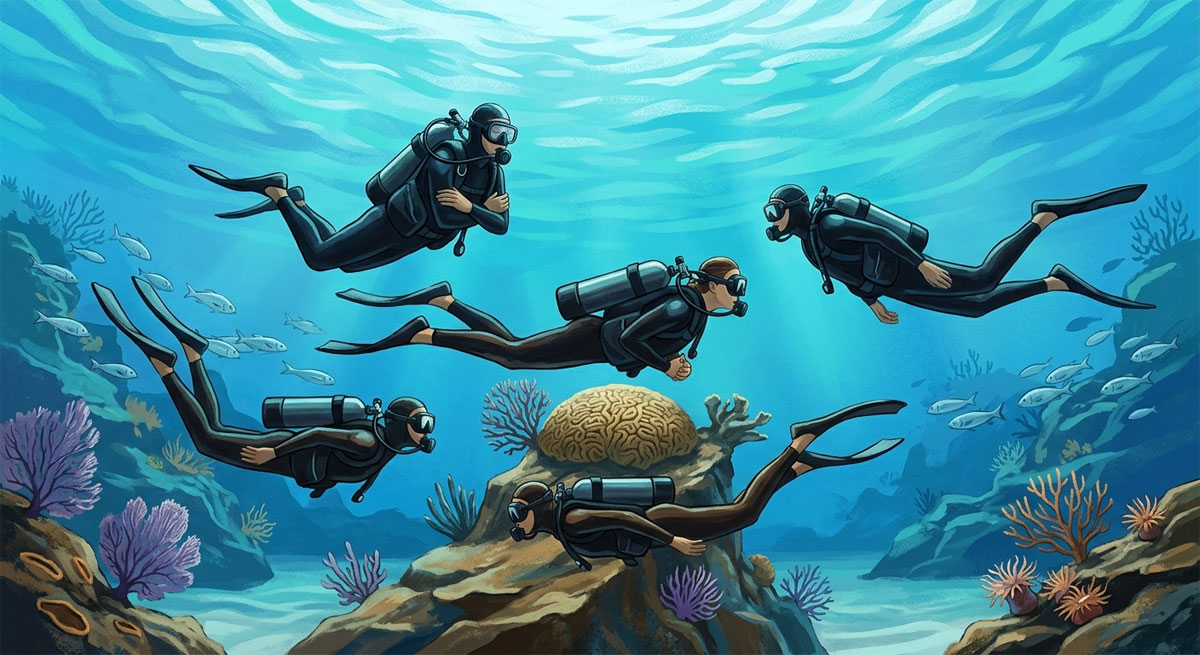
“Trim” refers to your physical body posture in the water. Ideally, you want to be completely horizontal, parallel to the sea floor, with your knees bent at a 90-degree angle. If your body is positioned diagonally with your feet pointing down, every time you kick forward, your fins will actually propel you upward, throwing off your buoyancy.
Actionable Tip: If your feet are constantly sinking, you need to shift your center of gravity. Try moving some of the weights from your waist belt to the trim pockets on the back of your BCD, or move your cylinder slightly higher up on your back.
Use Your BCD Sparingly
When you do need to use your BCD – like when descending to the bottom or compensating for the compression of your wetsuit at depth – do it with patience.
Actionable Tip: Use the inflator and deflator buttons in tiny, half-second bursts (“micro-adjustments”). Add a tiny burst of air, wait a few seconds to see how your body reacts, and then decide if you need more. Never hold the button down in a panic, as this guarantees you will overshoot your desired depth.
Relax and Ditch the Hand-Swimming
Tension makes divers move erratically and breathe rapidly. When divers feel unstable, they often start trying to swim with their hands. Hand-swimming completely destabilizes your posture in the water.
Actionable Tip: Fold your arms across your chest or clasp your hands together in front of you. Rely solely on your fins for propulsion and your breath for buoyancy. Relax your shoulders, let the water support you, and trust your gear.
Practice Makes Perfect: Drills to Try
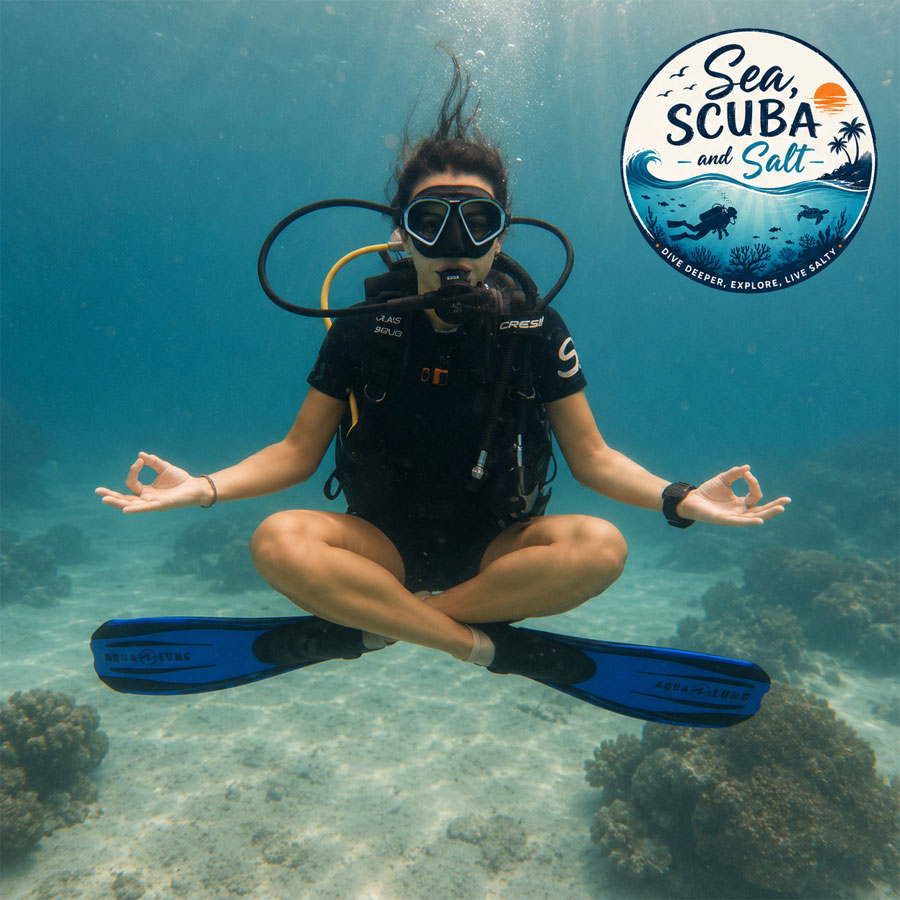
On your next dive, dedicate 5 to 10 minutes over a sandy patch to practice:
- The Fin Pivot: Lay flat on the sand, get neutrally buoyant, and use only your breathing to pivot up and down on the tips of your fins.
- The Buddha Hover: Cross your legs, fold your arms, and try to hover completely motionless mid-water for 60 seconds, using only your lungs to keep you in place.
Frequently Asked Questions (FAQs)
How do I know if I am overweighted while diving?
If you are overweighted, you will likely notice a few tell-tale signs: you drop like a rock during your initial descent, you swim in a diagonal “seahorse” position rather than horizontally, and you have to keep adding and venting massive amounts of air to your BCD throughout the dive just to maintain your depth.
Does my wetsuit affect my buoyancy?
Yes, significantly! Neoprene is filled with tiny nitrogen bubbles, making it highly buoyant. The thicker your wetsuit, the more lead weight you will need to sink. Furthermore, as you descend, the water pressure compresses these bubbles, meaning your wetsuit loses its buoyancy at depth, requiring you to add air to your BCD to compensate.
Should I use my BCD or my breathing to adjust my depth?
Use your BCD for macro adjustments and your lungs for micro adjustments. You use your BCD to compensate for the compression of your wetsuit at depth, or the fact that your scuba tank becomes lighter as you consume air. You use your breathing to navigate small depth changes, like gliding over a rock or dipping down to look under a ledge.
How does saltwater versus freshwater affect my weighting?
Saltwater is denser than freshwater, which means it provides more upward lift. Therefore, you are more buoyant in the ocean than you are in a lake or a cenote. If you usually dive in freshwater and are heading to the ocean, you will need to add extra weight to your belt (usually around 2 to 4 pounds, depending on your body mass and gear).
Is there a specialty course I can take to get better at this?
Absolutely! Most major dive agencies offer specialized training. PADI offers the “Peak Performance Buoyancy” (PPB) specialty, and SSI offers the “Perfect Buoyancy” course. These courses are highly recommended for beginners and focus entirely on weighting, trim, breath control, and hovering techniques under the guidance of a professional instructor.