Secrets of the Abyss: How Deep-Sea Sponges Thrive in the Dark
When we gear up for a dive, we usually picture the vibrant, sunlit world of colorful coral reefs or dense kelp forests teeming with fish. This shallow, sun-drenched zone is the ocean most of us know and love.
But beneath the reach of our dive lights lies a massive, mysterious world. By volume, roughly 95% of the ocean exists in permanent, cold darkness. Despite these seemingly hostile conditions, life does not just exist in the abyss—it finds ways to thrive.
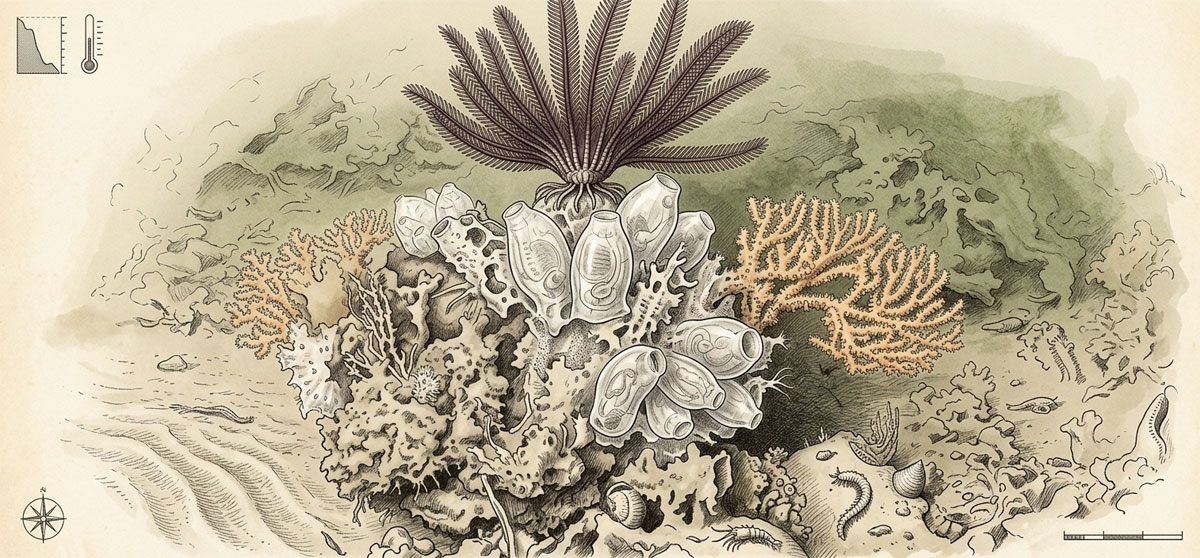
Among the most remarkable residents of these deep waters are deep-sea marine sponges. Far below recreational diving limits, these organisms form vast “sponge gardens” that act as crucial ecosystem engineers. Spanning thousands of square kilometers, they provide vital habitats for countless seafloor creatures.
A recent study published in the journal Microbiome has shed light on how these deep-sea sponges survive without sunlight, revealing some fascinating survival strategies.
The Power of Sponge Gardens
To understand how important these organisms are, it helps to look at their daily work. Individual sponges can pump and filter thousands of liters of water every single day. As they filter, they release nutrients that support neighboring marine life.
Yet, for a long time, marine scientists have wondered how these animals manage to thrive in such nutrient-poor, pitch-black environments.
The secret lies in symbiosis. Much like the shallow-water corals that rely on photosynthetic algae, deep-sea sponges partner with specialized microbes to survive.
Two Clever Survival Strategies in One Sponge
Researchers recently analyzed Calyx sponges collected from a depth of 830 meters (over 2,700 feet). They discovered that the sponge’s microbial partners use a two-pronged strategy to generate energy and nutrients.
1. Chemosynthesis: Turning “Waste” into Food
About 16% of the microbes inside the sponge use a process called chemosynthesis.
Like all animals, sponges produce waste, including ammonia. In the dark depths, these clever microbes use this ammonia waste as an energy source. They combine it with dissolved carbon dioxide in the water to build biomass.
While shallow-water corals use sunlight to build biomass (photosynthesis), these deep-sea microbes use chemical reactions to achieve the same goal in complete darkness.
2. Specialized Recycling: Digesting the Indigestible
The remaining 84% of the sponge’s microbial partners rely on heterotrophy—meaning they must consume organic matter to survive.
The challenge in the deep sea is that food is incredibly scarce. Organic matter (like dead plankton and algae) that drifts down from the surface gets picked clean by bacteria and small crustaceans long before it reaches the seafloor. By the time it hits the bottom, only the tough, hard-to-digest “skeletons” of algae are left.
However, researchers found that these heterotrophic microbes possess specialized enzymes capable of breaking down complex compounds like pectin and xylan—the tough cell walls of algae. By digesting these leftovers, the microbes create nutrients that their host sponge can easily use.
Why Deep-Sea Sponges Matter to the Ocean
These sponges and their microbial partners function as complex, living recycling plants. By converting ammonia, carbon dioxide, and tough organic waste into usable biomass, they kickstart the local food web. This biomass ultimately supports larger deep-sea creatures, such as brittle stars and deep-water fish.
Essentially, these deep-sea sponge gardens lay the foundation for entire ecosystems in the cold, dark depths.
Protecting What Lies Below
Unfortunately, these fragile ecosystems are facing growing threats from human activity.
- Deep-sea trawling physically destroys delicate sponge structures that have taken years to grow.
- Deep-sea mining operations, targeting rare metals on the seabed, risk disrupting these habitats in ways that could take centuries to recover.
The United Nations has formally recognized deep-sea sponge gardens as Vulnerable Marine Ecosystems. While this is an important step, recognition alone isn’t enough to protect them.
As ocean lovers and divers, we understand the delicate balance of marine life. Protecting the deep ocean is just as critical as protecting the shallow reefs we visit. If we damage these deep-sea habitats before we truly understand them, we risk disrupting global cycles—like the carbon cycle—in ways we are only beginning to comprehend.