Meet Microeledone galapagensis: The Tiny Blue Galápagos Octopus
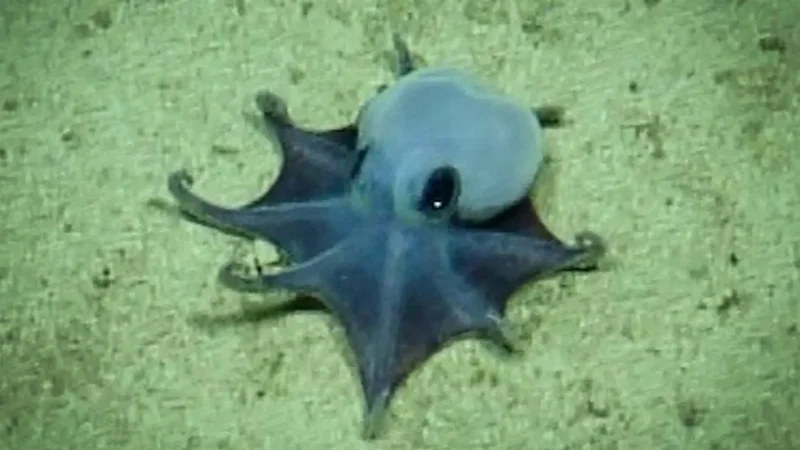
Nearly 6,000 feet beneath the ocean’s surface, everything is usually swallowed by pitch-black darkness. But during a 2015 deep-sea expedition near the Galápagos Islands, a brilliant, golf ball-sized pop of vibrant blue drifted across a camera feed and completely stole the show.
Researchers aboard the exploration vessel E/V Nautilus were piloting a remotely operated vehicle (ROV) along the seafloor near Darwin Island when they spotted the miniature cephalopod. They literally couldn’t contain their excitement. The ROV’s audio feed captured their pure delight: “He’s tiny!” one researcher exclaimed. “It’s blue!” said another, comparing the squishy invertebrate to a plushie. “Is that a cute little guy, or what?”
Now, over a decade later, this adorable deep-sea dweller has officially been named Microeledone galapagensis in a newly published study in the journal Zootaxa. And as it turns out, the tiny octopus is just as scientifically rebellious as it is cute.
A One-of-a-Kind Puzzle
During their expedition, the team managed to film two other similar octopuses and successfully scooped up a single female specimen. Eventually, the preserved octopus made its way to Janet Voight, a cephalopod expert and Curator Emerita of Invertebrates at Chicago’s Field Museum.
“Right away, I knew it was something really special,” Voight recalled. “I’d never seen anything like it”.
But Voight faced a major scientific dilemma. Usually, officially describing a new octopus species requires a full physical dissection to examine the animal’s internal anatomy, like its mouth, beak, and teeth. Because this was the only physical specimen of M. galapagensis ever collected, Voight refused to destroy it.
Enter the magic of modern technology. Teaming up with Stephanie Smith, the Field Museum’s X-ray CT laboratory manager, the researchers used non-destructive micro-computed tomography (CT) scanning. By compiling thousands of razor-thin X-ray images, they successfully built a highly detailed 3D model of the octopus’s insides.
“There’s nothing like spending the day looking at something no other human has ever seen,” Smith said of the privilege of virtually opening up the rare specimen.
Small Octopus, Big Taxonomic Shake-Up
Microeledone galapagensis didn’t just stand out because of its vibrant hue—blue is considered one of the rarest colors in nature. It also completely upended a textbook marine biology definition!
The tiny blue creature belongs to a family of octopuses called Megaleledonidae. Historically, scientists defined this family as exclusively large-bodied octopuses endemic to the freezing, remote waters of the Southern Ocean around Antarctica. The squat, short-armed M. galapagensis, living 5,800 feet deep in the equatorial tropics of the Pacific, boldly breaks every single one of those rules.
Beyond rewriting taxonomy, the golf ball-sized octopus marks a sweet personal milestone for the research team. Despite studying octopus evolution for more than 40 years, this is the very first time Janet Voight has officially led the description of a new octopus species.
“These are little octopuses that live in the deep sea, and hardly anybody on Earth has ever gotten to see them,” Voight shared. “I just feel lucky that I got to work with them”.
With the Pacific Ocean covering more of the planet than all landmasses combined, one has to wonder: what other incredibly cute, colorful, and rule-breaking creatures are waiting for us in the deep?